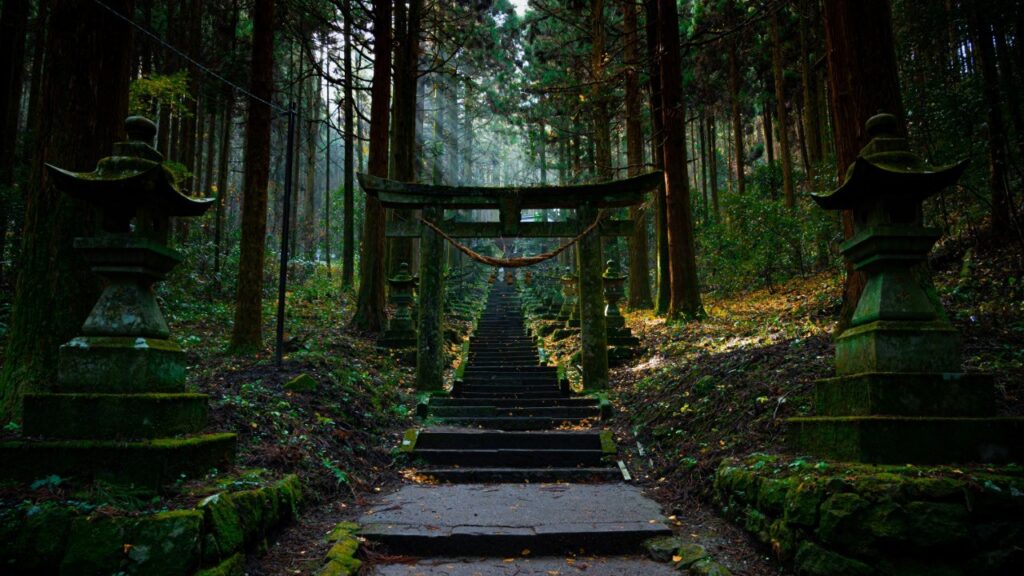
Travel through Japan for a few days, and you may find yourself visiting far more shrines and temples than you expected. You pass beneath a vermilion gate, climb a moss-covered stone stairway, or stand before a hall where incense drifts through the air. The setting may feel unmistakably Japanese, yet it is easy to leave without really knowing whether you have just visited a Shinto shrine or a Buddhist temple—or what many of the things around you actually meant.
A little context changes the experience. Why is there a gate at the entrance? Why do people clap at one place but not another? Why are Buddhist statues visible in some sacred spaces, while the most sacred part of a shrine may be hidden from view?
You do not need to study Japanese religion in depth to enjoy these places more. This guide is simply meant to help you recognize a few important clues, visit respectfully, and notice details you might otherwise miss. On your next visit, even one small moment of recognition can make a familiar-looking scene feel different.
Shrine or Temple? Start With What You Can See
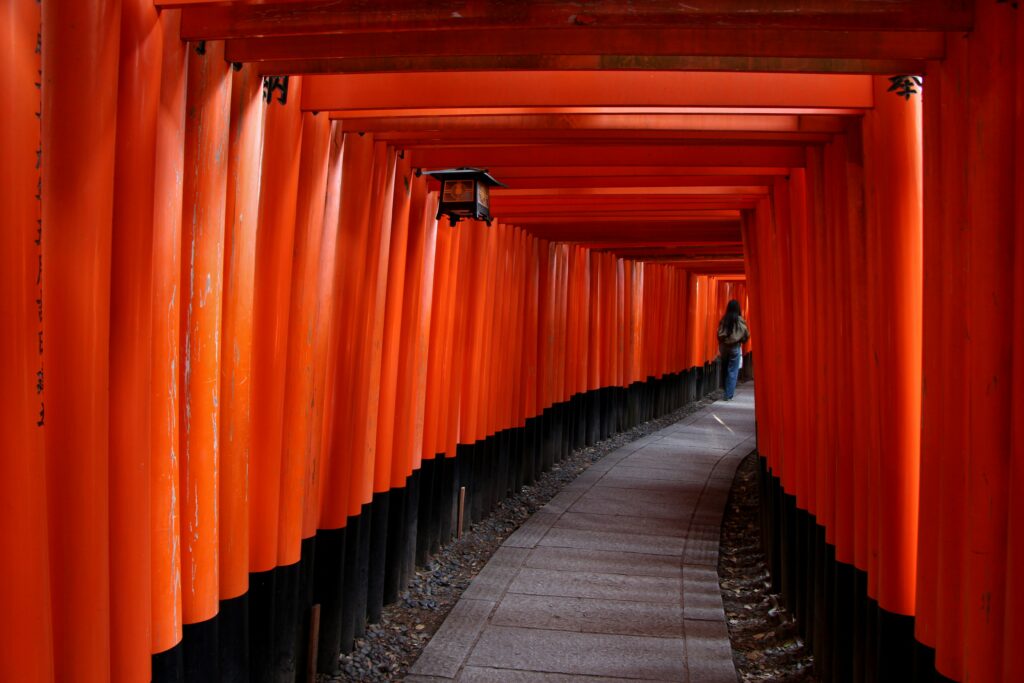
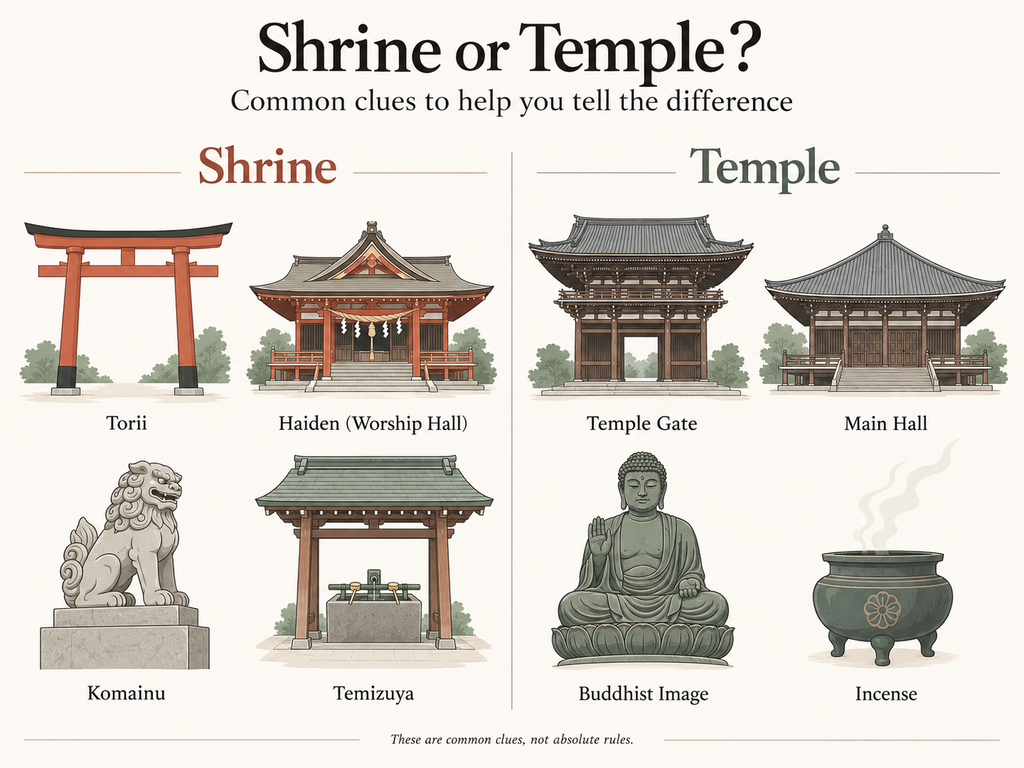
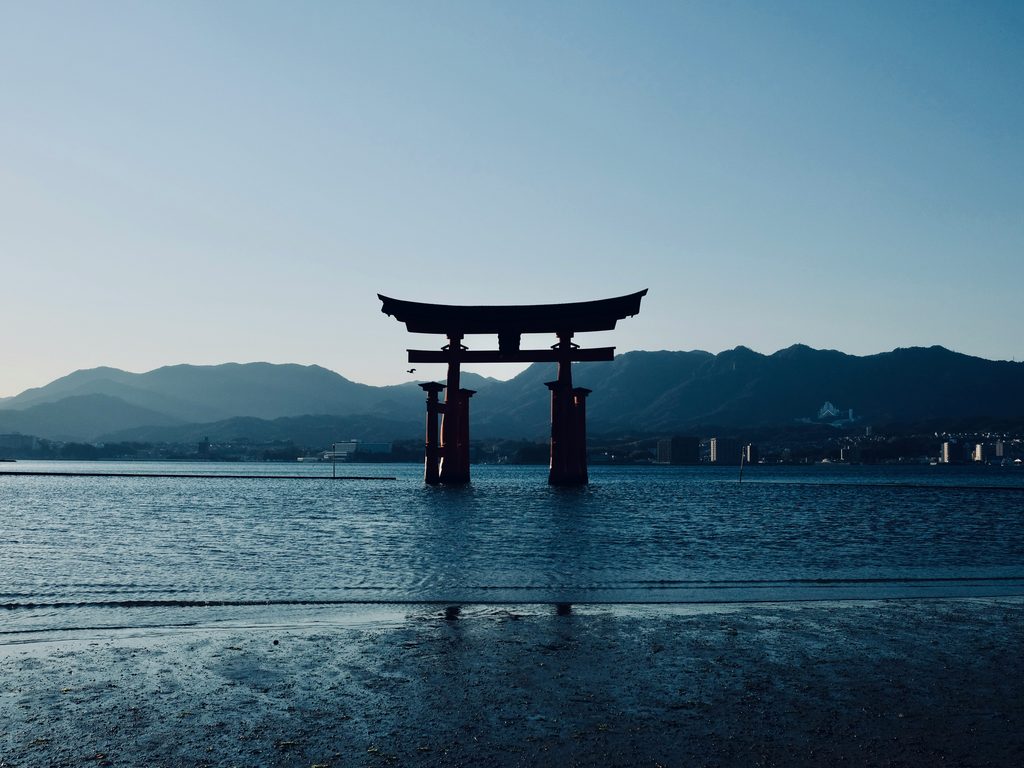
The easiest place to begin is at the entrance. A torii is one of the clearest signs that you are entering a Shinto shrine, marking a transition from everyday space into sacred ground. The bright vermilion torii seen at famous shrines are only one type; torii can also be made of unpainted wood, stone, or metal.
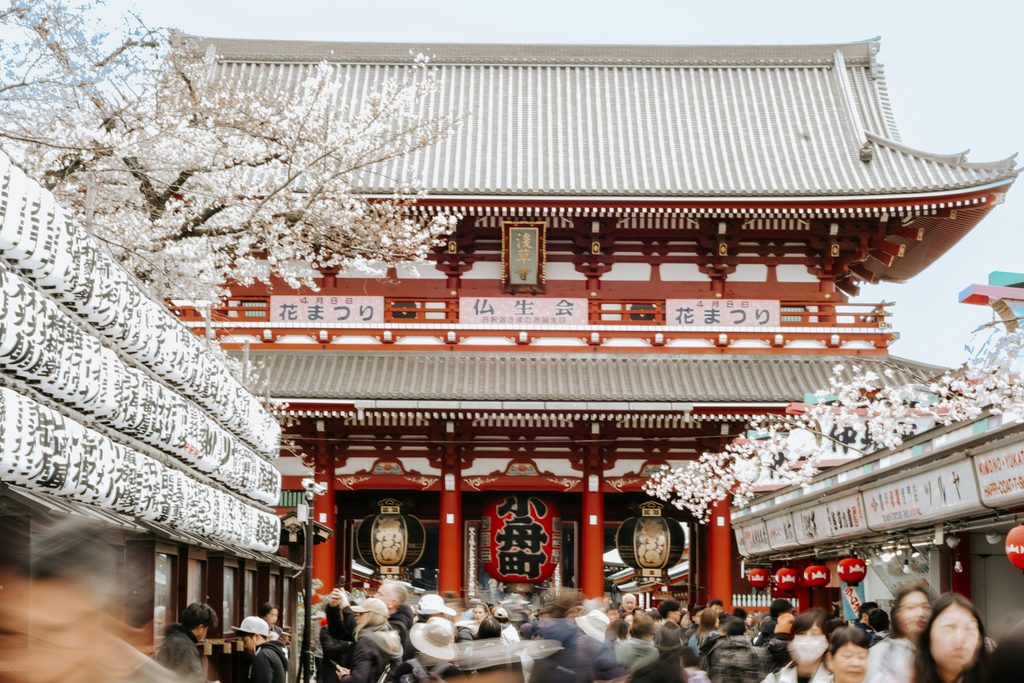
Buddhist temples, by contrast, often have substantial roofed gates, sometimes called sanmon. At larger temples, these gates can be impressive structures in their own right, with guardian figures standing on either side. Once inside, more clues appear: shrines may have a worship hall, komainu, sacred ropes, and a purification basin, while temples may have Buddhist statues, incense, bells, pagodas, or a main hall containing sacred images.
None of these should be treated as a perfect identification test. Religious sites across Japan vary enormously in size, age, architecture, and local tradition, so it is more useful to think in terms of common clues than rigid rules.
What to Notice at a Shinto Shrine
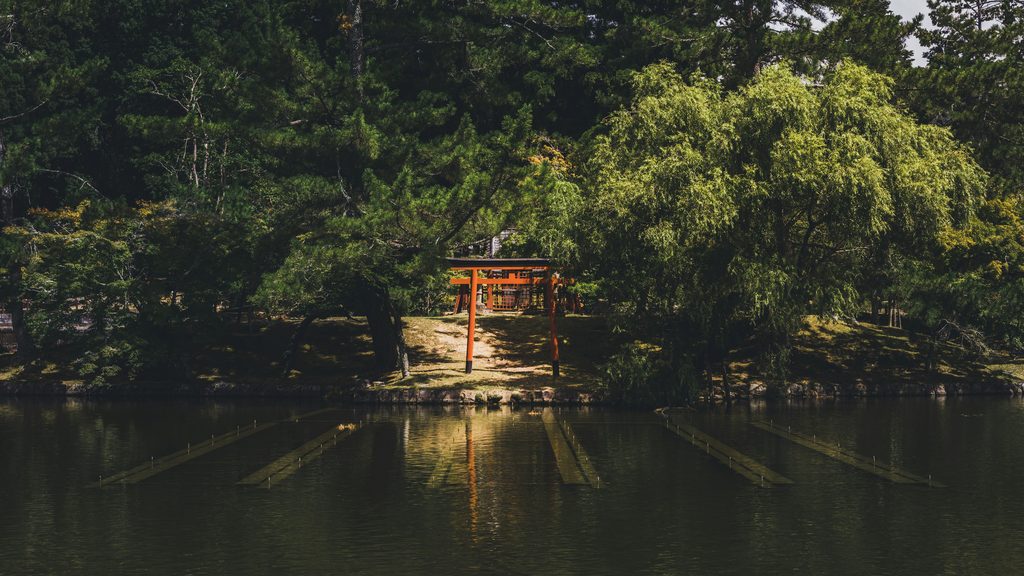
Torii
A torii is more than a photogenic gate: it marks the entrance to sacred space. Once you know that, passing beneath one can feel less like walking through an ornament and more like crossing a threshold. At larger shrines, you may pass through several torii before reaching the main buildings; Fushimi Inari Taisha in Kyoto is famous for its thousands of torii, but even a single weathered gate at a small neighborhood shrine serves the same basic purpose. When you pass through one, notice what changes beyond it: the path, the sound, the trees, the distance from the road, or the way the approach draws your attention inward.
Haiden — the Worship Hall
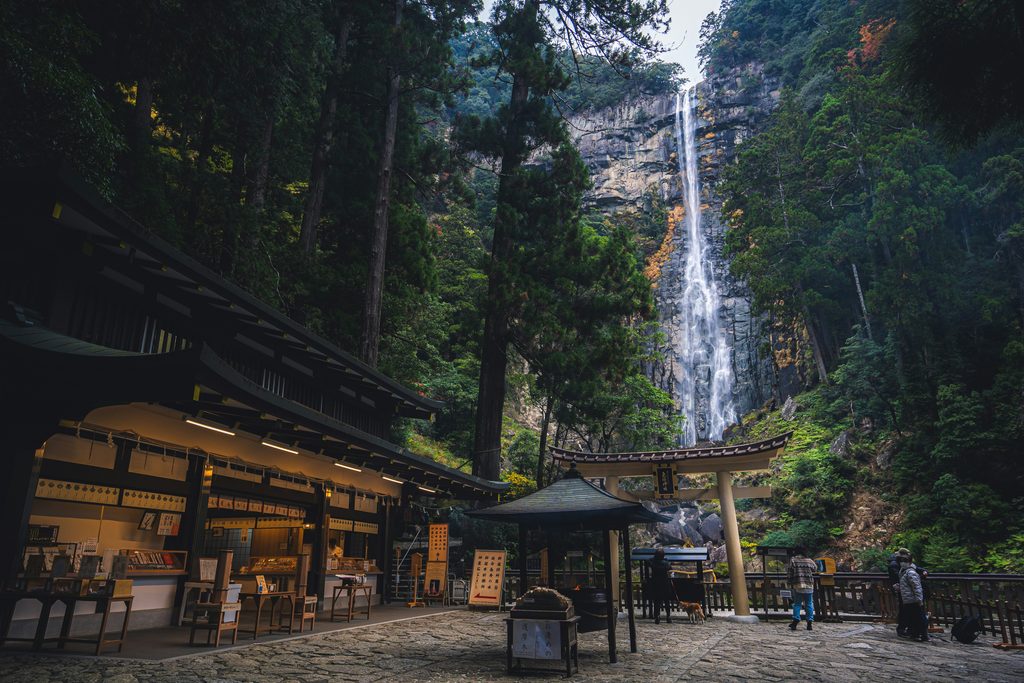
At many shrines, the building where visitors stop to pray is the haiden, or worship hall. This is often where you will find the offering box and, at some shrines, a bell rope. It is easy to assume that the large building in front of you is simply “the main shrine,” but another, more sacred structure may stand behind it.
Honden — the Main Sanctuary
The honden is the sanctuary where the kami is enshrined, and ordinary visitors generally do not enter it. Depending on the shrine, it may stand directly behind the worship hall or be partly hidden from view. That relationship is worth noticing: visitors pray in the space in front, while the shrine’s most sacred area lies beyond. Knowing this gives you a different way to look at the buildings, rather than seeing them simply as a collection of beautiful roofs and wooden structures.
Komainu — Guardian Figures
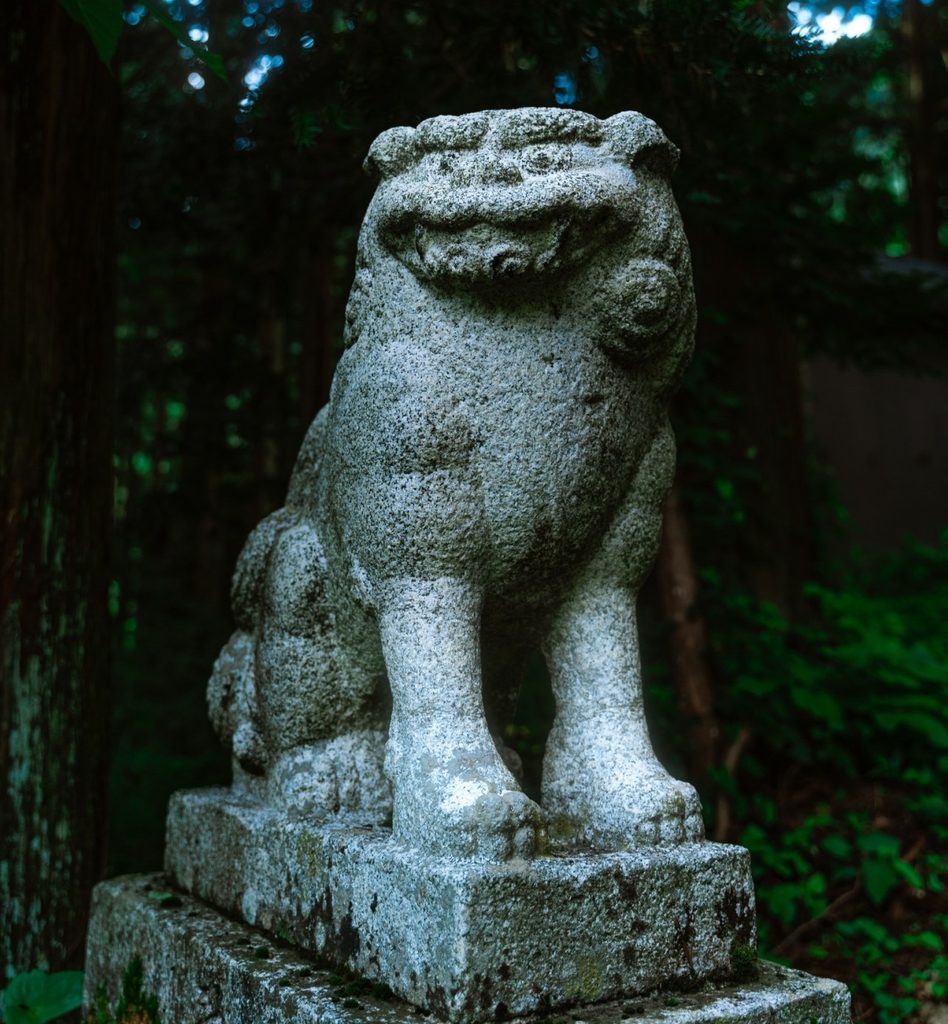
Many shrines have a pair of komainu, often described in English as lion-dogs, near an entrance or important building. One may have its mouth open while the other has its mouth closed. They guard sacred space, but they are not the only animals you may encounter: foxes are closely associated with Inari shrines, cattle appear at shrines connected with Tenjin, and other animals may have local or religious significance. If the same animal appears again and again, it is often worth wondering why.
What to Notice at a Buddhist Temple
The Temple Gate
A Buddhist temple may begin with a substantial gate rather than an open torii. Some are modest, while others are remarkable works of architecture. At major temples, guardian figures may stand within the gate; the great Nandaimon at Todaiji in Nara is a famous example, with enormous Nio guardians flanking the entrance.
The gate is not just something to pass through on the way to the “real” attraction. It is often part of the experience itself.
The Main Hall
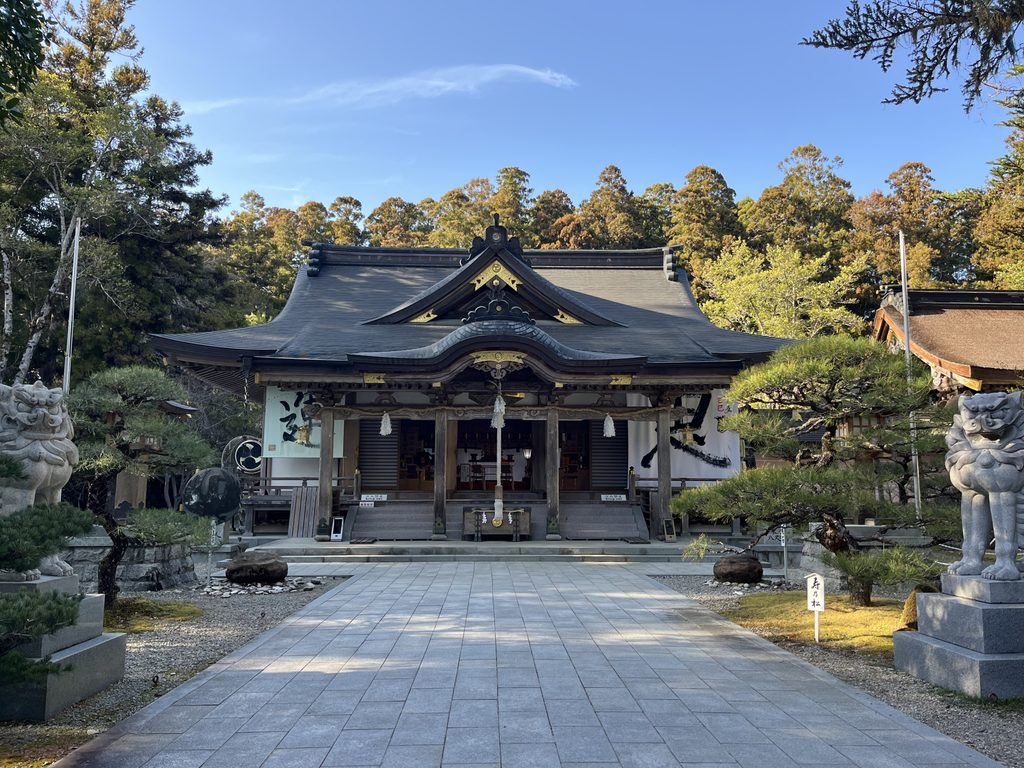
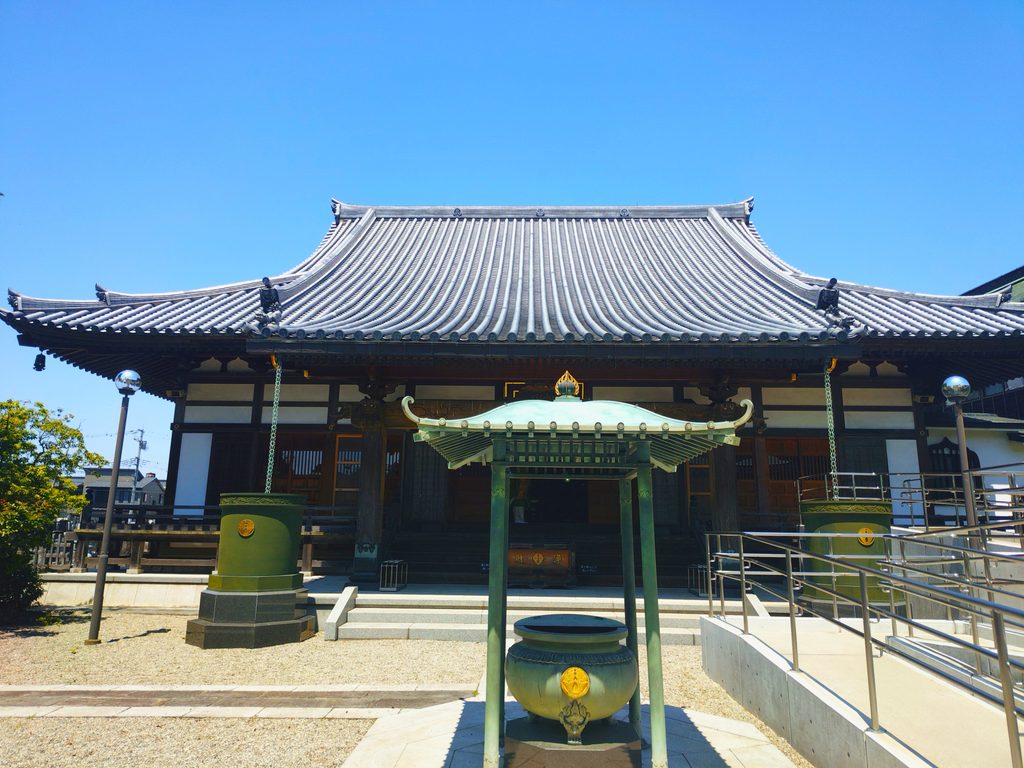
The central worship building at a Buddhist temple is often translated simply as the main hall. Its Japanese name varies from temple to temple, and travelers do not need to memorize every term. What matters is its role: this is the main space of Buddhist worship, often housing or honoring the temple’s principal sacred image.
Buddhist Images
At many Buddhist temples, sacred figures are represented in statues and paintings. That is often one of the clearest visual differences from a Shinto shrine, where the kami is usually not represented for worship in the form of a visible statue. You may encounter Amida Buddha, Kannon, Jizo, or many other figures, but you do not need to identify them all.
Who is being honored here, and what do you notice about the figure?
Its expression, posture, hand gestures, or the objects it holds may all tell part of the story. Even without specialist knowledge, paying attention to the image can turn a dim temple hall from “another old building” into a place with its own distinct character.
Incense, Bells, and Pagodas
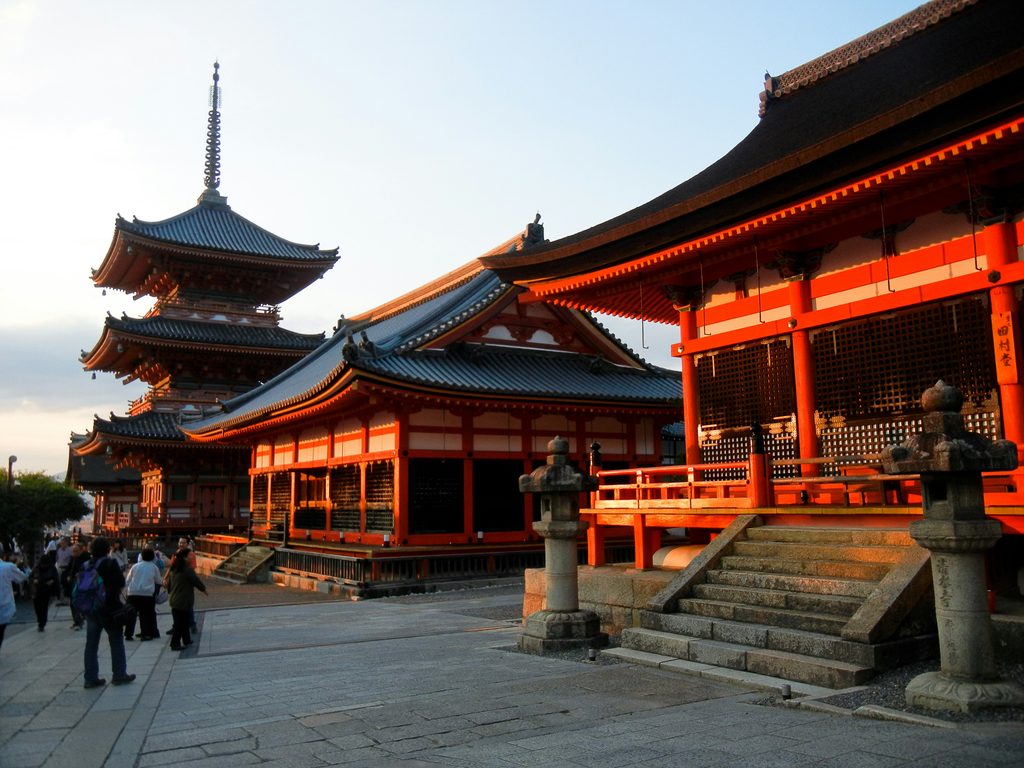
Incense smoke, bell towers, and multi-story pagodas are all familiar parts of the visual language of Japanese Buddhism, but they are clues rather than requirements. Not every temple has a pagoda, not every visitor burns incense, and not every hall is open to the public. The point is not to complete a checklist, but to recognize these elements when you encounter them.
How to Visit Without Worrying About Doing Everything Perfectly
Shrines and temples are often major tourist destinations, but they are also active places of worship. You do not need to perform every ritual perfectly.
Observe, be quiet, and follow the instructions of the place you are visiting.
At a Shrine
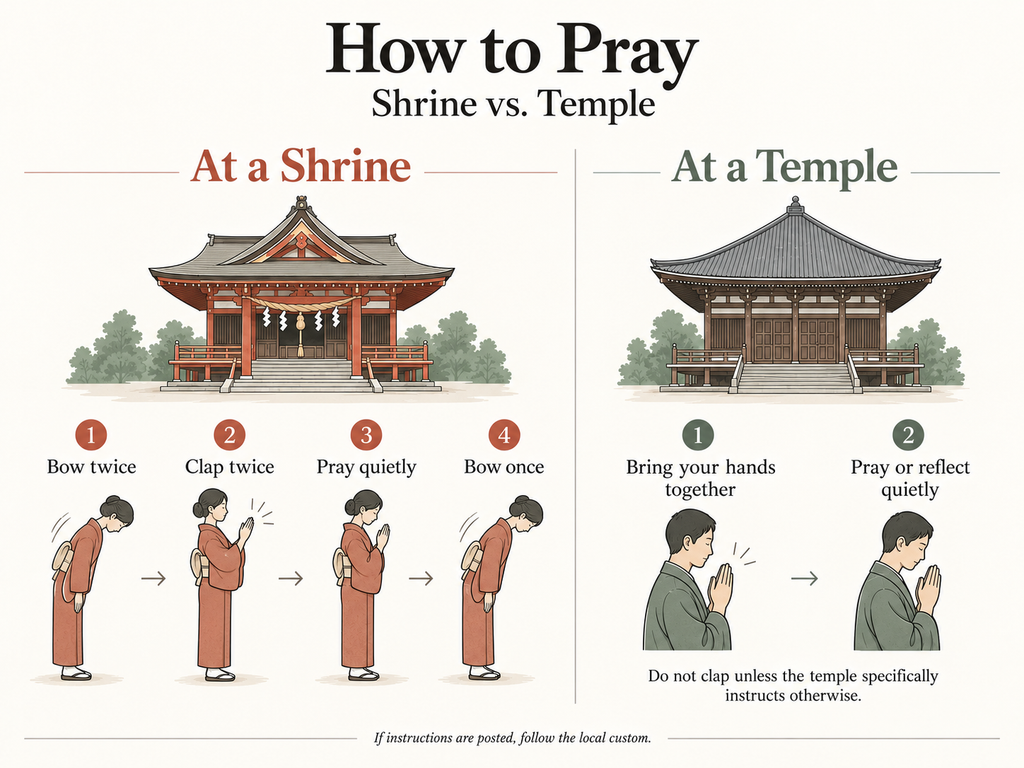
A standard form of prayer used at many shrines is often summarized as two bows, two claps, one bow. Make an offering if you wish, bow twice, clap twice, pray quietly, and bow once more. Some shrines have different traditions, so if instructions are posted, follow them.
If you forget the order, do not worry. The point is to approach the place respectfully, not to perform a ritual for show.
You may also wonder what to say during the quiet moment of prayer. There is no need for a formal speech. One simple approach is to state your name and where you are from, express gratitude, and then share a hope or goal. Rather than simply asking for something, you might say what you intend to work toward and ask for guidance or support along the way. A few sincere thoughts are enough.
At a Buddhist Temple
At a Buddhist temple, you generally do not clap. A simple approach is enough: approach quietly, make an offering if appropriate, bring your hands together, and pray, reflect, or stand silently. Practices vary among temples and Buddhist traditions, so local guidance should always come first.
There is no single prayer that applies to every temple or Buddhist tradition. You might express gratitude, reflect on your own life, pray for someone’s well-being, remember someone who has died, or simply stand quietly before the principal image. If the temple provides specific instructions or a chant, follow the guidance given there.
Shoes and Photography
You may be asked to remove your shoes before entering certain buildings, and photography may be restricted inside halls, especially where sacred images are kept. Do not assume that photography is allowed simply because other visitors have their cameras out. Look for signs, and if you are unsure, ask or refrain from taking the photo.
How to Use a Temizuya
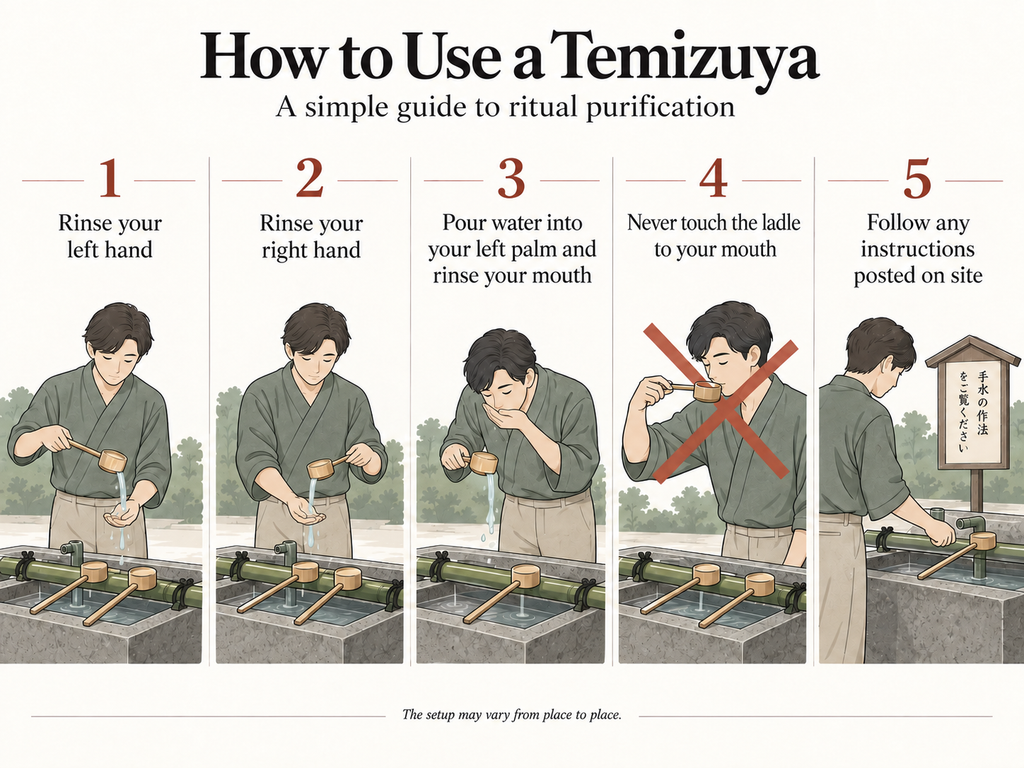
At many shrines—and at some temples—you will find a temizuya (also called a chozuya), a water basin used for ritual purification before worship. The standard sequence is to rinse your left hand, then your right, pour water into your left palm to rinse your mouth, and never put the ladle directly to your lips.
The setup varies from place to place, so posted instructions should take priority. The important idea is not to perform the ritual flawlessly, but to understand that the water marks a moment of purification before you approach the sacred space.
Even a Tourist Attraction Is Still a Religious Site
Some of Japan’s most famous shrines and temples receive enormous numbers of visitors. They appear in guidebooks, on social media, and in travel videos, and some are among the most photographed places in the country. That does not make them ordinary public spaces.
Religion may not always be highly visible in everyday life in Japan, but shrines and temples are still places where people come to pray, make offerings, mark important moments in their lives, or simply spend a quiet moment. Treating the precinct as nothing more than a backdrop can easily become disrespectful.
That includes using the grounds as a stage for disruptive dance or performance videos, hanging from or climbing on torii or buildings, touching objects that are not meant to be handled, entering roped-off areas, or removing things from the grounds that are not clearly meant to be taken. Even where photography is allowed, blocking a prayer area for repeated takes, making excessive noise, or filming worshippers intrusively can interfere with people who are there to pray.
If a sign says photography is prohibited, respect it. If an area is fenced, roped off, or marked as restricted, stay outside it. If you are not sure whether you may touch or take something, leave it alone; you do not need a deep understanding of Shinto or Buddhism to behave respectfully.
This may be a sightseeing destination for you, but it is still a place of prayer for someone else.
Why Shrines and Temples Sometimes Seem to Overlap
By this point, shrines and temples may sound fairly easy to distinguish. Yet while traveling in Japan, you may come across a Buddhist temple with something that looks unmistakably Shinto, or a sacred landscape where shrine and temple elements seem unusually close together. There is a reason.
Buddhism arrived in Japan in the 6th century, and over the centuries that followed, Buddhist traditions and kami worship did not develop in completely separate worlds. They interacted, overlapped, and influenced one another: temples were built near shrines, kami could be honored within Buddhist settings, and Buddhist priests and rituals sometimes became part of shrine life.
This long history of interaction is often described as shinbutsu-shugo, the blending of kami worship and Buddhism. In 1868, the Meiji government began formally separating Shinto and Buddhism. Today, shrines and temples are distinct religious institutions, but more than a thousand years of shared history did not disappear without a trace.
A Place Where You Can Still See the Connection
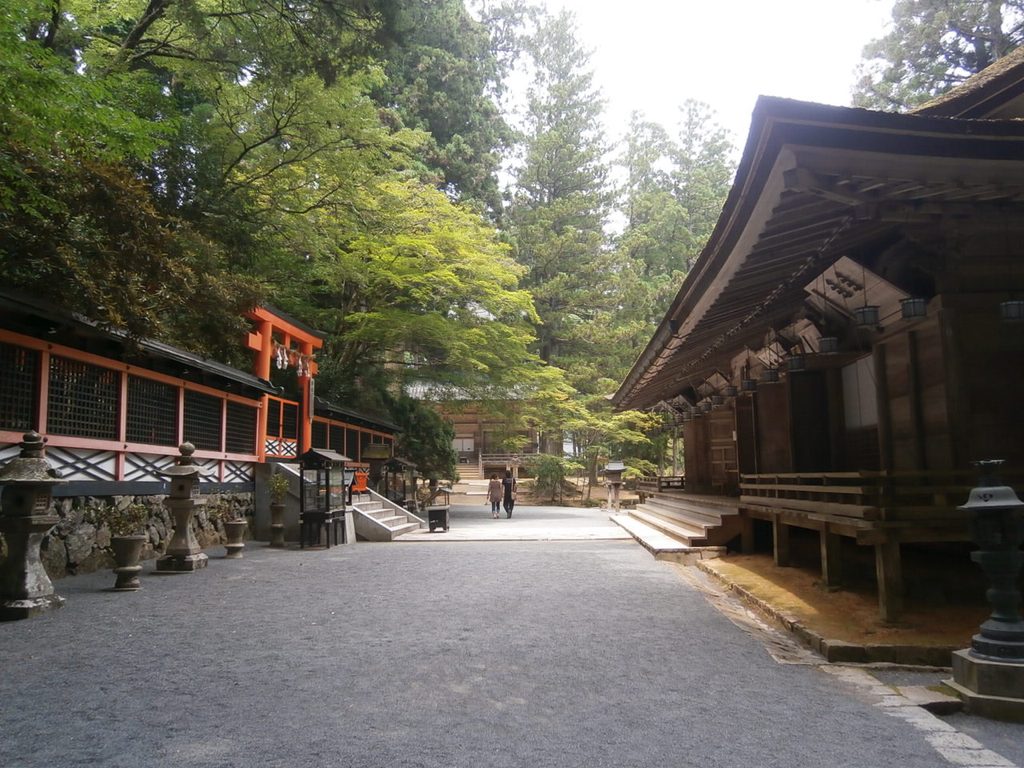
Koyasan is one of Japan’s most important Buddhist sacred sites, yet within the Danjo Garan complex stands Miyashiro, a sanctuary dedicated to local kami. If you have just learned to think of shrines and temples as separate, the sight can be surprising: why is a Shinto-style sanctuary standing inside such an important Buddhist landscape?
The answer lies in that older history of coexistence. Kami worship and Buddhism were not always separated into the tidy categories travelers see today. You can notice the same kind of historical layering elsewhere: in Tokyo, Sensoji and Asakusa Shrine stand side by side, while in Nara, Kasuga Taisha and Kofukuji share centuries of intertwined history.
You do not need to know every historical detail. It is enough to recognize that when shrine and temple elements appear unexpectedly close together, you may be seeing a trace of Japan’s older religious landscape.
Look Again on Your Next Visit
Next time you enter a shrine or temple, try not to reach for your camera immediately. Look around first: is the entrance a torii or a temple gate? Are people clapping, or bringing their hands together in silence? Where are visitors allowed to approach, and what lies beyond?
Notice the guardian figures at the entrance and the sounds around you—bells, chanting, clapping, gravel underfoot, or simply wind moving through the trees. At famous sites, it is easy to rush from one “must-see” feature to the next, but slowing down for even a minute can change the experience.
You do not need to memorize every architectural term or understand the entire history of Japanese religion. If you leave your next shrine or temple thinking, “I noticed something I would have missed before,” that is enough.